THANK YOU FOR SUBSCRIBING
× 
Construction Tech Review Weekly Brief
Be first to read the latest tech news, Industry Leader's Insights, and CIO interviews of medium and large enterprises exclusively from Construction Tech Review


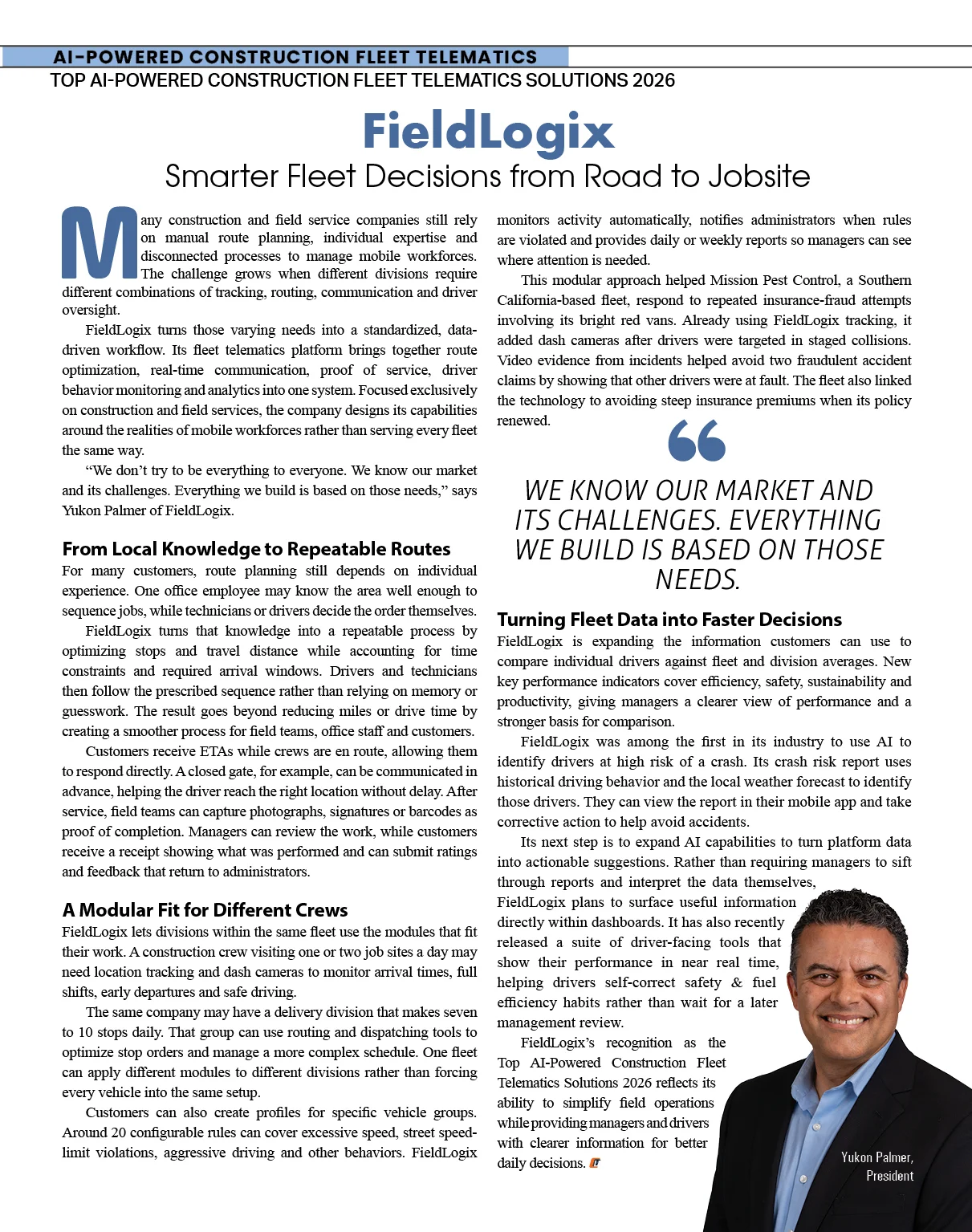
 Yukon Palmer, President
FieldLogix turns those varying needs into a standardized, data-driven workflow. Its fleet telematics platform brings together route optimization, real-time communication, proof of service, driver behavior monitoring and analytics into one system. Focused exclusively on construction and field services, the company designs its capabilities around the realities of mobile workforces rather than serving every fleet the same way.
“We don’t try to be everything to everyone. We know our market and its challenges. Everything we build is based on those needs,” says Yukon Palmer of FieldLogix.
From Local Knowledge to Repeatable Routes
For many customers, route planning still depends on individual experience. One office employee may know the area well enough to sequence jobs, while technicians or drivers decide the order themselves.
FieldLogix turns that knowledge into a repeatable process by optimizing stops and travel distance while accounting for time constraints and required arrival windows. Drivers and technicians then follow the prescribed sequence rather than relying on memory or guesswork. The result goes beyond reducing miles or drive time by creating a smoother process for field teams, office staff and customers.
Customers receive ETAs while crews are en route, allowing them to respond directly. A closed gate, for example, can be communicated in advance, helping the driver reach the right location without delay. After service, field teams can capture photographs, signatures or barcodes as proof of completion. Managers can review the work, while customers receive a receipt showing what was performed and can submit ratings and feedback that return to administrators.
A Modular Fit for Different Crews
FieldLogix lets divisions within the same fleet use the modules that fit their work. A construction crew visiting one or two job sites a day may need location tracking and dash cameras to monitor arrival times, full shifts, early departures and safe driving.
The same company may have a delivery division that makes seven to 10 stops daily. That group can use routing and dispatching tools to optimize stop orders and manage a more complex schedule. One fleet can apply different modules to different divisions rather than forcing every vehicle into the same setup.
-
We know our market and its challenges. Everything we build is based on those needs.
Customers can also create profiles for specific vehicle groups. Around 20 configurable rules can cover excessive speed, street speed-limit violations, aggressive driving and other behaviors. FieldLogix monitors activity automatically, notifies administrators when rules are violated and provides daily or weekly reports so managers can see where attention is needed.
This modular approach helped Mission Pest Control, a Southern California-based fleet, respond to repeated insurance-fraud attempts involving its bright red vans. Already using FieldLogix tracking, it added dash cameras after drivers were targeted in staged collisions. Video evidence from incidents helped avoid two fraudulent accident claims by showing that other drivers were at fault. The fleet also linked the technology to avoiding steep insurance premiums when its policy renewed.
Turning Fleet Data into Faster Decisions
FieldLogix is expanding the information customers can use to compare individual drivers against fleet and division averages. New key performance indicators cover efficiency, safety, sustainability and productivity, giving managers a clearer view of performance and a stronger basis for comparison.
FieldLogix was among the first in its industry to use AI to identify drivers at high risk of a crash. Its crash risk report uses historical driving behavior and the local weather forecast to identify those drivers. They can view the report in their mobile app and take corrective action to help avoid accidents.
Its next step is to expand AI capabilities to turn platform data into actionable suggestions. Rather than requiring managers to sift through reports and interpret the data themselves, FieldLogix plans to surface useful information directly within dashboards. It has also recently released a suite of driver-facing tools that show their performance in near real time, helping drivers self-correct safety & fuel efficiency habits rather than wait for a later management review.
FieldLogix’s recognition as the Top AI-Powered Construction Fleet Telematics Solutions 2026 reflects its ability to simplify field operations while providing managers and drivers with clearer information for better daily decisions.
From Route Plans to Proof of Service in Construction Fleets
Construction fleets rarely move in one pattern. A crew may spend most of a day at one site while a delivery unit crosses the same metro area repeatedly. Telematics that treats both groups alike can produce more data without improving daily control. The stronger platforms let managers match supervision to the work being performed and preserve local scheduling constraints instead of relying on one dispatcher’s memory. That flexibility matters when one organization runs several fleet types under the same management structure.
Route planning deserves more scrutiny than a map with suggested stops. Construction work is shaped by arrival windows, site access and traffic. A useful system should turn those conditions into an ordered route that accounts for those constraints. Communication belongs in the same workflow. ETA messages and direct replies can help prevent a vehicle from reaching a closed gate or waiting for access while the office works from outdated information. The value is not merely fewer miles. It is tighter control over the gap between the planned day and the day that actually unfolds.
Proof of service is another dividing line. A location ping confirms presence, but it does not establish what happened at the stop. Photos and signatures, supported by barcode scans and job notes, give managers a clearer service record and give customers something more concrete than an arrival timestamp. That record should return to the office without a separate handoff. For fleets that invoice from field activity or face disputes over completed work, this can matter as much as routing accuracy.
Driver oversight needs similar precision. Blanket alerts can overwhelm managers, especially when different vehicle groups face different rules. A construction crew may need basic arrival monitoring, while a delivery group requires tighter route control. Configurable speed thresholds, posted-limit alerts, aggressive-driving rules and vehicle-level profiles let management apply different controls without forcing every division into one template. Reporting also has to help identify patterns rather than simply archive violations.
“FieldLogix’s modular structure allows different divisions to use different functions, while configurable profiles can apply distinct monitoring rules across vehicle groups.”
AI changes the buying decision only when it shortens the distance between fleet data and action. Scorecards and risk indicators can be useful, but only when managers can see what deserves attention without combing through multiple reports. Driver-facing feedback adds another layer by giving employees a chance to correct behavior while the information is still current. Executives should examine what the AI actually interprets and whether the output changes a decision that would otherwise require manual review.
FieldLogix combines GPS fleet telematics with route optimization, dispatching, driver behavior monitoring and optional dash cameras in a platform focused on construction and field service fleets. Its modular structure allows different divisions to use different functions, while configurable profiles can apply distinct monitoring rules across vehicle groups. Routing can account for stop constraints and send planned work to drivers. ETA communication remains within the same workflow. Field teams can also return proof of service through photos, signatures, barcode scans and job notes. Its AI-powered driver risk analysis adds a more focused layer to safety review. For construction fleets that need both field accountability and flexible fleet control, FieldLogix merits close consideration.
...Read more
AI-Powered Construction Fleet Telematics Solutions Info
Q1
What Do AI-Powered Construction Fleet Telematics Solutions Help Construction Teams Manage?
AI-Powered Construction Fleet Telematics Solutions combine vehicle tracking, route planning, driver monitoring and operational data in one platform. These tools help construction teams understand where vehicles are, how drivers perform and whether scheduled visits are completed as planned. By connecting field activity with office oversight, organizations can reduce manual coordination and make better decisions about travel time, workforce deployment and service delivery. The right system also gives managers a clearer view of daily fleet activity without relying entirely on phone calls or individual driver knowledge.
Q2
How Does FieldLogix Apply AI-Powered Construction Fleet Telematics Solutions to Field Operations?
FieldLogix focuses on construction and field service operations through a platform that combines route optimization, real-time communication, proof of service, driver behavior monitoring and analytics. Its routing tools account for stop sequences, travel distances and required arrival windows, helping teams follow repeatable schedules. Drivers can share updates while traveling, while completed jobs can be documented through photographs, signatures or barcodes. These AI-Powered Construction Fleet Telematics Solutions connect field activity with administrative oversight, giving managers and customers more visibility into service progress and completion.
Q3
Which Features Matter Most When Evaluating Construction Fleet Tracking Technology?
Useful features depend on fleet size, daily schedules and the level of oversight required. AI-Powered Construction Fleet Telematics Solutions may combine GPS tracking, routing and dispatching, dash cameras, driver safety monitoring and performance reports. Organizations should consider whether the system can accommodate different vehicle groups, provide timely location updates and flag behaviors that require attention. Configurable alerts and accessible reporting also help managers identify recurring problems. A practical evaluation should consider how easily the available functions fit existing workflows rather than assuming every vehicle needs the same tools.
Q4
How Can Fleet Telematics Improve Driver Safety and Accountability?
AI-Powered Construction Fleet Telematics Solutions help managers review driving patterns, identify potential risks and provide feedback based on recorded activity. Speeding, aggressive driving and other configurable rule violations can trigger notifications and appear in periodic reports. Some systems also use historical driving behavior and other relevant information to identify drivers who may face elevated crash risk. Dash camera footage can provide additional context when incidents occur. These capabilities support more informed safety reviews, although alerts and analytics should complement appropriate training, supervision and established safety procedures.
Q5
How Can Modular Telematics Support Different Fleet Requirements?
Construction organizations may operate vehicles with different schedules and responsibilities, making flexibility an important consideration. AI-Powered Construction Fleet Telematics Solutions can allow managers to select functions according to each group's needs. A crew visiting a small number of job sites may prioritize location tracking and camera monitoring, while a division handling frequent daily stops may need route sequencing and dispatch tools. Separating these requirements helps organizations avoid applying an identical configuration across every vehicle. Managers can then review relevant performance information without adding unnecessary steps to each team's routine.
Q6
How Can Fleet Analytics Support Better Operational Decisions?
AI-Powered Construction Fleet Telematics Solutions give managers a basis for comparing performance across drivers, vehicles and divisions. Measures related to efficiency, safety, sustainability and productivity can reveal patterns that require attention. Driver-facing performance information can also encourage earlier adjustments to driving habits and fuel use. FieldLogix is expanding its analytics and AI capabilities to surface actionable suggestions through dashboards, reducing the need to interpret multiple reports manually. These insights can support more consistent decisions about fleet performance while keeping human review central to operational planning.
| Share this Article: Tweet |

Company
FieldLogix
Management
Yukon Palmer, President
Description
FieldLogix provides fleet telematics technology for construction and field service companies, combining route optimization, real-time communication, proof of service, driver monitoring and analytics in one platform. Its modular tools help mobile workforces improve routing, visibility, safety and performance.
Top
